
The Trials Of Ms Americana127 Patched -
The "127" in the title is not a version number. It is a coordinate. A prison cell. A statutory limit. And "Patched" is both a verb (to fix) and a noun (a piece of fabric sewn over a hole). To understand Ms. Americana127 , you must first understand that she was never whole. She was always waiting for the patch. To discuss the Patched version, one must recall the controversy of the original, unpatched Trials of Ms. Americana126 . That build was a disaster of ambition. Players controlled "Missy," a beauty queen from a dying Rust Belt town, as she navigated a series of Socratic trials based on the seven deadly sins, but re-skinned for the modern political landscape.
The game opens with Ms. Americana127 (no longer Missy; she has shed her surname) waking up on a server rack made of bleachers and apple pie tins. She has a literal tear running down her cheek—not a tear of emotion, but a texture tear. A graphical glitch. The objective screen reads:
Is the patch worth it? The game doesn't answer. It just gives you the needle and thread. What you sew is up to you. the trials of ms americana127 patched
Given that this appears to be a specific title (potentially from a game mod, a piece of interactive fiction, a digital art project, or a niche ARG), this article will analyze the symbolic weight of the title as if it were a major cultural release. It treats "Ms. Americana127" as an archetype and "Patched" as a meta-narrative on modern American identity. Introduction: The Girl in the Server In the sprawling, chaotic landscape of 21st-century digital media, few titles have sparked as much quiet, academic fury and cult adoration as The Trials of Ms. Americana127 Patched . Released not by a major studio, but by the anonymous collective known only as "The Foundry," the game (or is it a visual novel? A psychological horror?) defies easy categorization. It arrived on Steam in late 2025 as a "patch" to an original 2022 title that barely existed—a clever meta-joke that launched a thousand think-pieces.
The 126 version was infamous for its "unwinnable state." After the third trial (Gluttony, re-imagined as corporate land acquisition), the game would enter a loop. Ms. Americana would stand in front of a mirror, her polygonal face glitching, repeating the line: "The code of ethics is deprecated." Critics called it "frustratingly brilliant" or "lazy nihilism." Fans found a debug command that revealed a hidden integer: AmericanDream.exe - Status: 0x127 . The "127" in the title is not a version number
For example, early in the game, you defend a small farmer against a mega-agricorp. Later, to get a necessary keycard, you must patch that memory, turning the farmer into a tax evader. You literally rewrite history. The game tracks these "Retcons." The more you patch, the more stable the game becomes, but the more "de-authored" Ms. Americana feels.
Thus, 127 was born. The patch was not a bug fix; it was a sequel. The genius of Ms. Americana127 Patched lies in its dual mechanics: The Sewing and The Patching . A statutory limit
In most games, a patch is invisible. You download it, the game runs smoother, you never think about the binary surgery. In Ms. Americana127 , the protagonist is acutely aware that she has been "versioned."
eFatigue gives you everything you need to perform state-of-the-art fatigue analysis over the web. Click here to learn more about eFatigue.
The Trials Of Ms Americana127 Patched -
Welds may be analyzed with any fatigue method, stress-life, strain-life or crack growth. Use of these methods is difficult because of the inherent uncertainties in a welded joint. For example, what is the local stress concentration factor for a weld where the local weld toe radius is not known? Similarly, what are the material properties of the heat affected zone where the crack will eventually nucleate. One way to overcome these limitations is to test welded joints rather than traditional material specimens and use this information for the safe design of a welded structure.
One of the most comprehensive sources for designing welded structures is the Brittish Standard Fatigue Design and Assessment of Steel Structures BS7608 : 1993. It provides standard SN curves for welds.
Weld Classifications
For purposes of evaluating fatigue, weld joints are divided into several classes. The classification of a weld joint depends on:
- the macroscopic geometry of the pieces welded,
- the direction of the cyclic stresses, and
- the location of the crack that leads to failure.
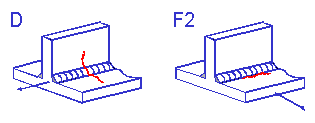
Two fillet welds are shown below. One is loaded parallel to the weld toe ( Class D ) and the other loaded perpendicular to the weld toe ( Class F2 ).
It is then assumed that any complex weld geometry can be described by one of the standard classifications.
Material Properties
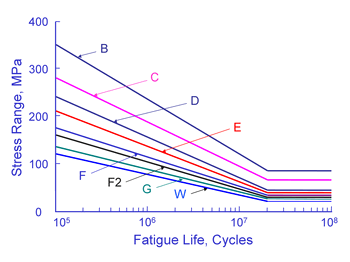
The curves shown above are valid for structural steel welds. Fatigue lives are not dependant on either the material or the applied mean stress. Welds are known to contain small cracks from the welding process. As a result, the majority of the fatigue life is spent in growing these small cracks. Fatigue lives are not dependant on material because all structural steels have about the same crack growth rate. The crack growth rate in aluminum is about ten times faster than steel and aluminum welds have much lower fatigue resistance. Welding produces residual stresses at or near the yield strength of the material. The as welded condition results in the worst possible residual or mean stress and an external mean stress will not increase the weld toe stresses because of plastic deformation. Fatigue lives are computed from a simple power function.

The constant C is the intercept at 1 cycle and is tabulated in the standard. This constant is much larger than the ultimate strength of the material.
The standard is only valid for fatigue lives in excess of 105 cycles and limits the stress to 80% of the yield strength. Experience has shown that the SN curves provide reasonable estimates for higher stress levels and shorter lives. In eFatigue, the maximum stress range permitted is limited by the ultimate strength of the material for all weld classes.
Design Criteria
Test data for welded members has considerable scatter as shown below for butt and fillet welds.
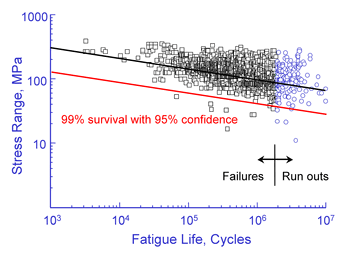
Some of this scatter is reduced with the classification system that accounts for differences between the various joint details. The standard give the standard deviation of the various weld classification SN curves.
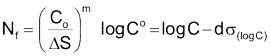
The design criteria d is used to determine the probability of failure and is the number of standard deviations away from the mean. For example d = 2 corresponds to a 2.3% probability of failure and d = 3 corresponds to a probability of failure of 0.14%.
© 2026 Sharp Domain