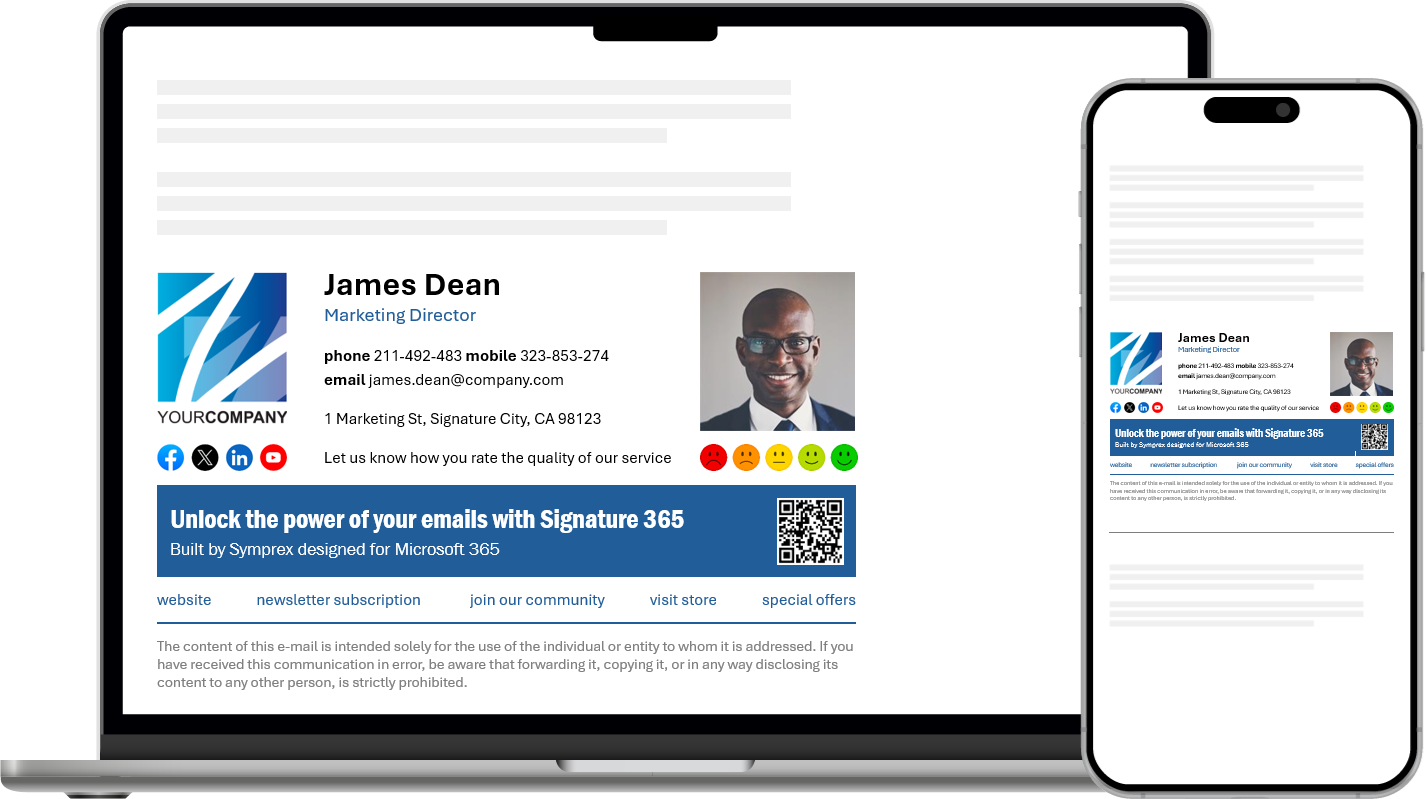
Discover the new way to manage email signatures, campaigns, and disclaimers
Create eye-catching email signatures that work in all email clients on all devices.
Manage all your company's email signatures from a single, intuitive dashboard.
Get up and running in no time with our easy-to-use interface and templates.
Add campaign banners and track impressions and conversions.
Ensure all emails include required legal disclaimers and comply with regulations.
Certified to ISO 27001, ISO 27018 and SOC 2, and compliant with GDPR, CCPA and HIPAA.
Empower your brand in every email
Everything is managed from the cloud dashboard. It has never been easier to manage signatures, campaigns, and disclaimers.
Choose a template that works for you and add the branding, headshots, contact details and social media that you need.
Integrate with Microsoft 365 and more.
Signatures are visible when composing email in Outlook on all devices. Taskpane lets users select signatures, edit fields, and change settings.
Equally quick and easy to setup whether you have 10 or 10,000 users
The setup wizard gets you set up in no time including integration with Microsoft 365 and Outlook clients.
Choose a template, or create your own, and add branding, headshots, contact details, social media, campaign banners and disclaimers.
Once you are happy with your new signatures, you can integrate them in all employee emails with a single click from your dashboard.
In this article, we will deconstruct each component of the keyword, explain why it is becoming a “hot” topic, diagnose the potential errors behind it, and provide actionable solutions to secure or modernize your web assets. To understand why people are searching for this, we must first dissect the anatomy of the phrase. What is SHTML? SHTML stands for Server Parsed HTML . Unlike a standard .html file, an .shtml file is processed by the web server before being sent to the client’s browser. This processing allows the server to look for SSI (Server Side Includes) directives.
grep "indexframe.shtml" /var/log/apache2/access.log | grep "hot" | awk 'print $1' | sort | uniq -c This command lists IP addresses hammering your indexframe.shtml with the hot parameter. A high count suggests a botnet or a DDoS attempt. Frames are obsolete in HTML5. If you still rely on them, consider refactoring. A simple JavaScript snippet in indexframe.shtml can prevent clickjacking: view indexframe shtml hot
Redirect 301 /indexframe.shtml /new-index.html Frames break browser history, bookmarks, and SEO. Convert your frameset into a responsive layout using CSS Grid or Flexbox. The navigation that once lived in a leftframe.shtml can now be a <nav> element loaded on every page. Phase 4: Monitor the 404s After migration, continue to monitor access.log for the old “view indexframe shtml hot” queries. If you still see them after 6 months, consider a permanent redirect to a support page explaining the legacy removal. Part 6: Is “Hot” a New Vulnerability CVE? A final, critical analysis: Is there a known CVE (Common Vulnerabilities and Exposures) specifically for “view indexframe shtml hot”? As of this writing, no major CVE uses that exact phrase . However, SSI injection vulnerabilities are tracked under CWE-97 (Improper Neutralization of Server-Side Includes). If a zero-day exploit begins using the hot parameter as a vector, it will likely be assigned a new CVE within days. In this article, we will deconstruct each component
Join thousands of companies that trust Symprex for their email signature needs